Three SCOTUS decisions demonstrate the urgency of court reform.
July 1, 2026

The Supreme Court released its final three rulings of the 2025-2026 term on Tuesday. There is cause for celebration in the holding of the birthright citizenship case. But there is a dire warning embedded in each of the three opinions issued Tuesday: The reactionary majority poses an existential threat to the Constitution, American democracy, and the rule of law.
Before turning to the threat to democracy posed by the reactionary majority in general, we should pause to acknowledge that the holding in the birthright citizenship case is a tremendous relief for all Americans, especially so for the millions of children under 18 whose citizenship status would have been implicated by a decision holding that the president can override the Constitution by executive order. (See FN 1.)
Thankfully, a 5-4 majority held that the plain language of the 14th Amendment means what it says, i.e., “All persons born or naturalized in the United States, and subject to the jurisdiction thereof, are citizens of the United States.”
Tens of millions of Americans are breathing a sigh of relief on Tuesday evening, knowing that their citizenship status is secure—for now. As with all things Trump, he refuses to take “No” for an answer and is already urging Congress to pass legislation to override the 14th Amendment—which is, of course, a logical absurdity. Or at least it should be.
As noted, only 5 justices agreed with the reasoning that the 14th Amendment means what it says, i.e., “all persons” means “all persons.” Kavanaugh concurred in the result but issued a bizarre dissent in which he suggested that although Trump could not override the Constitution by executive order, Congress could do so by statute. (It is long past time for Yale Law School to revoke Kavanaugh’s law degree; he should have flunked every course he took at Yale, based on his illiterate opinions on the Supreme Court.)
The opinion is here: Trump v. Barbara. Justice Roberts’ majority opinion reviews English common law and the Civil Rights Act of 1866 (which preceded the 14th Amendment) to conclude that the Framers of the 14th Amendment intended for all persons born in the US to be citizens, period.
Roberts rights:
Citizenship, then and now, was the right to have rights— to freely participate in our political community. The Framers of the Fourteenth Amendment extended that promise to “every free-born person in this land.” We keep that promise today.
It is astounding that four justices of the Supreme Court believe that the 14th Amendment does not mean what its plain language says, even when that language is buttressed by centuries of common law and a century of Supreme Court precedent. The views espoused by Thomas, Alito, Gorsuch, and Kavanaugh are part of a lunatic, ahistorical fever dream that the Old South will rise again.
Commentators struggled to describe the fact that four justices disputed the Constitution's text. See, e.g., Ian Millhiser, Vox, The Supreme Court just came one vote away from a constitutional catastrophe.
Millhiser writes,
When Judge John Coughenour, a Reagan appointee who was the first judge to block Trump’s attempt to strip citizenship from many Americans born in this country, announced that decision, he said that he’s “been on the bench for over four decades” and he “can’t remember another case where the question presented is as clear as this one is.”
It’s not just that the Constitution is clear. The Supreme Court also held more than a century ago, in United States v. Wong Kim Ark (1898), that the Constitution means what it says. The question in Barbara, which was whether Trump can simply cancel the citizenship of people born in the US, may be the easiest question that has reached the justices in anyone’s lifetime.
See also Mark Joseph Stern, Slate, The Supreme Court’s 5–4 vote in the birthright citizenship case is a scandal.
Stern writes,
But the margin is a scandal. It is nothing short of stunning that Trump came one vote away from persuading the Supreme Court to repeal the bedrock of the Reconstruction Amendments based on a brazenly partisan contortion of their text and history. A view held only by fringe, far-right nativists until very recently has secured support from four of the nine members of the court: Justices Clarence Thomas, Samuel Alito, Neil Gorsuch, and Brett Kavanaugh.
As Millhiser notes, “if Donald Trump gets to replace just one member of the Barbara majority, the United States enters a very dark place.”
The members of the Barbara majority are Roberts, Barrett, Sotomayor, Kagan, and Jackson. While no imminent retirements are expected among that group, illness is always a threat. We stand but one vote away from a majority of the Supreme Court striking down the key provision of the 14th Amendment, despite the amendment’s plain language.
The conservative majority thus represents one of the greatest threats to the Constitution that our nation faces today. If we do not engage in radical reform of the Supreme Court to protect the Constitution, we will have proved ourselves unworthy of the freedoms and liberties guaranteed by our nation’s charter.
Before turning to our role in protecting the Constitution (see Concluding Thoughts), we should pause to reflect on the towering concurrence by Justice Ketanji Brown Jackson. A direct link to Justice Jackson’s dissent is here: Trump v. Barbara, 609 U. S. ___, ___ (2026) (Jackson, J., concurring) (slip op., at 32).
Justice Jackson concurs fully in Justice Roberts’ opinion, but calls out Justice Thomas’ dissent:
Despite his longstanding endorsement of a “colorblind” Constitution, Justice Thomas now surprisingly suggests that the Citizenship Clause was a race-conscious remedial measure, relating only to “freed slaves such as Dred Scott.”
Justice Jackson then engages in a tour de force of historical scholarship, demonstrating that the 14th Amendment adopted a “universalist” approach to ensure that the phrase “all persons” covered all persons, not merely “freed slaves” as argued by Justice Thomas.
Justice Jackson writes,
As I have shown in this opinion, the Fourteenth Amendment is not color-blind; rather, its core principle is that our Nation does not tolerate racial caste—i.e., the systemic subordination that many (even some who opposed slavery) had wished to perpetuate after the Civil War.
So, the architects of the Second Founding did not think or pretend that race didn’t matter. Quite to the contrary, they understood that race made an enormous difference to the lived experiences of all concerned—and to the fate of our union. Indeed, it is for that very reason that a radical restructuring was required.
The Citizenship Clause applies universally precisely because such universal application was necessary to achieve the Amendment’s own race-conscious remedial purposes.
If you have time, reading Justice Jackson’s concurrence is well worth the effort. Her concurrence educates and empowers all of us to be better, more engaged citizens.
The takeaway from the Supreme Court’s decision in Trump v. Barbara is that if we do not act swiftly and boldly, the Roberts Court may eliminate the 14th Amendment from the Constitution.
Coda: Brett Kavanaugh suggested in his concurrence that Congress can override the 14th Amendment by passing legislation. (Again, Yale, please revoke Kavanaugh’s law degree ASAP!) Predictably, Trump has called on Congress to pass legislation limiting birthright citizenship. The right-wing media is now attacking Justice Barrett, calling her a “DEI” hire. And some MAGA influencers are calling for an expansion of the Supreme Court to compensate for the recent “liberal” votes by Roberts and Barrett in the mail ballot grace period and birthright citizenship cases.
If the above does not convince us that we must act quickly to expand the Court with an overwhelmingly liberal majority, nothing will.
The reactionary majority strikes down campaign finance limits for political parties
In a 6-3 ruling, Justice Kavanaugh wrote for the majority in an opinion striking down campaign finance limitations applicable to political parties. In doing so, Kavanaugh overturned a 2001 Supreme Court precedent, again demonstrating the Roberts Court’s contempt for precedent. See NPR, Supreme Court strikes down limits on political party spending.
Kavanaugh wrote that there was little evidence of corruption in spending by political parties—which, of course, raises the question of whether the campaign finance limitations are the reason for relatively low levels of party corruption. In Kavanaugh’s view, a law designed to prevent corruption is necessary only if it is ineffective. (Again, Yale. Law degree. Kavanaugh. Revoke.)
When we expand the Court to overwhelm the reactionary majority, one of the first cases to be overruled must be Citizens United (and related decisions). The flood of money in politics is disenfranchising American voters and giving billionaires disproportionate control over elections, legislatures, judges, and policy.
The reactionary majority upholds the ban on transgender athletes in women’s sports.
In a decision with broad implications, Justice Kavanaugh again wrote for a 6-3 majority to hold that the term “sex” under Title IX meant “biological sex.” According to Kavanaugh, that means that bans on transgender athletes in girls’ sports are lawful. See Erin in the Morning, Supreme Court Rules Title IX Means “Biological Sex” In Devastating Anti-Trans Ruling.
Although Kavanaugh claimed that the ruling was narrow, saying that it did not decide whether schools must ban transgender athletes from participating in girls’ sports, we can expect the Trump administration to use the ruling as a cudgel to force all schools into compliance with the views expressed by Kavanaugh. Moreover, we can expect schools with sports bans to broaden their discrimination against transgender students by imposing restrictions on bathrooms, housing, medical care, and employment.
As noted by Chris Geidner in his Substack, Kavanaugh refuses to call the affected athletes “transgender girls” or “transgender women.” Geidner writes,
In Kavanaugh’s opinion, he never once calls the people involved in these cases “transgender girls” or “transgender women,” despite that being who he was failing to protect on Tuesday. He generally — at least 13 times — instead referred to “biological males who identify as” girls or women. Even when referring to transgender people, it was by using a non-gendered term like “transgender athletes” or “transgender students.” This erasure is stigmatic, despite his effort at other points to put forward a softer tone.
MAGA has decided to target transgender people for discrimination because they believe they can get away with it. That is the playbook of every authoritarian regime whose plan is to discriminate against larger groups.
While we should protect the rights of transgender people because they are people entitled to the same protections under the Constitution as all other people, we must resist the efforts by MAGA to use discrimination against transgender people as a wedge to unwind hard-won rights of LGBTQ people, women, and racial minorities.
Concluding Thoughts
There is much more to talk about (Trump’s corruption, recent positive polling for Democrats in Texas, the deteriorating situation in the Middle East). I will discuss those topics tomorrow.
It is encouraging to hear elected officials and commentators finally acknowledging that expanding the Court is necessary. Harry Litman said on Chris Hayes’ show on Tuesday evening that he was a very reluctant convert to Court expansion, but now sees that other remedies, like term limits and constitutional amendments, would take too long to change the Court's direction. We are one vote away from eliminating the 14th Amendment to the Constitution. If we do not act quickly and boldly, the victories of the Civil War will be erased.
Some who have finally come around to expanding the Court want to do the minimum expansion necessary to out-vote the reactionary majority by adding four justices. A limited expansion of four justices is a bad idea. It would face all the opposition of a larger expansion, but would result in a 7-to-6 liberal majority. But that advantage could be erased by a single illness, resignation, or change of heart by one member of the seven-person liberal majority.
The 9th Circuit Court of Appeals has 27 judges and operates just fine. But if the Supreme Court had only 17 justices (for example), that would create a liberal majority of 11 justices with a 5-vote advantage (11-to-6). I think the best number is 27, to allow the Court to split into panels to divide the work of overruling Dobbs, Citizens United, Trump v. US, Callais, Shelby County v. Holder, and a dozen other decisions by the Roberts Court.
A frequent objection to expanding the Court is, “But won’t Republicans just do the same thing?” Of course they will—if they ever win a trifecta, which they won’t if we have the courage to expand the Court, eliminate the filibuster, and pass legislation to mandate that states use independent redistricting commissions.
But even if Republicans were to win a trifecta, they would have to expand the Court significantly to overcome the advantage of a large expansion by Democrats. So, if the Court were 27 justices, Republicans would have to expand the Court to somewhere in the range of 50 justices to overcome the liberal advantage.
Ridiculous, you say? Is it any more ridiculous than a Court that is one vote away from eliminating the 14th Amendment to the Constitution because Trump was able to appoint three justices? A court that can be destroyed by such a slight change in personnel is a fragile creature unable to withstand corrupting influences.
Moreover, as Josh Marshall notes, increasing the size of the Supreme Court will, paradoxically, reduce its centrality in American politics. See Talking Points Memo, Will GOPers Just Expand the Court Too? Probably. And That’s Okay.
As Marshall writes,
[T] here’s a very good chance that Republicans will do the exact same thing as soon as they get a trifecta. But this is largely a self-correcting problem. Because successive expansions will have the effect both of reducing the centrality of the Court in our politics, as well as the importance of any single Justice. And that’s good.
We want the Supreme Court to be more limited in its interventions into our politics, and we want to reduce the perceived advantages of stacking or corrupting it again.
One of the most salutary impacts of expanding the Court will simply be to send the message “You spent half a century building the machinery for stacking the Court with corrupt ideologues, then you did it, and now it’s gone.” Poof.
We will get one chance to get this right—when we win a trifecta in 2028. We cannot surrender to half-measures or agonize over no-longer-relevant concerns about preserving the Court’s non-existent legitimacy. By expanding the Court, we will be protecting the Constitution, which is the first order of business. When the Supreme Court begins to honor the Constitution once again, its legitimacy will return, slowly but surely.
That’s all for today! It has been a rough week, but we are still standing—and that is all we need to continue the fight.
Stay strong!
FN 1: Trump’s executive order ending birthright citizenship was prospective only, meaning that approximately 260,000 children born each year would have been directly affected if the Court had upheld Trump’s executive order. See Pew Research Center, About 9% of U.S. births in 2023 were to unauthorized or temporary legal immigrant mothers. But if the Court had upheld the executive order, the citizenship status of millions of existing birthright citizens under 18 would have become vulnerable to future attacks. See Pew Research Center (11/1/2018), U.S. births to unauthorized immigrants have fallen since 2007. I could find no estimate of the total number of US citizens of all ages who would have been subject to a birthright citizenship attack if Trump v. Barbara had upheld the executive order, but if there were 5 million minors under 18 who would have been vulnerable in 2016 (per Pew Research Center), a reasonable inference suggests that a decade later the total population of vulnerable birthright citizens of all ages exceeds 10 million.
Pro-democracy protest photos

June 30, Lebanon, New Hampshire
=================================

The Delaney Hall Pop-up Peace Choir sings in protest at the entrance of the Facility. Newark, NJ.
=================================
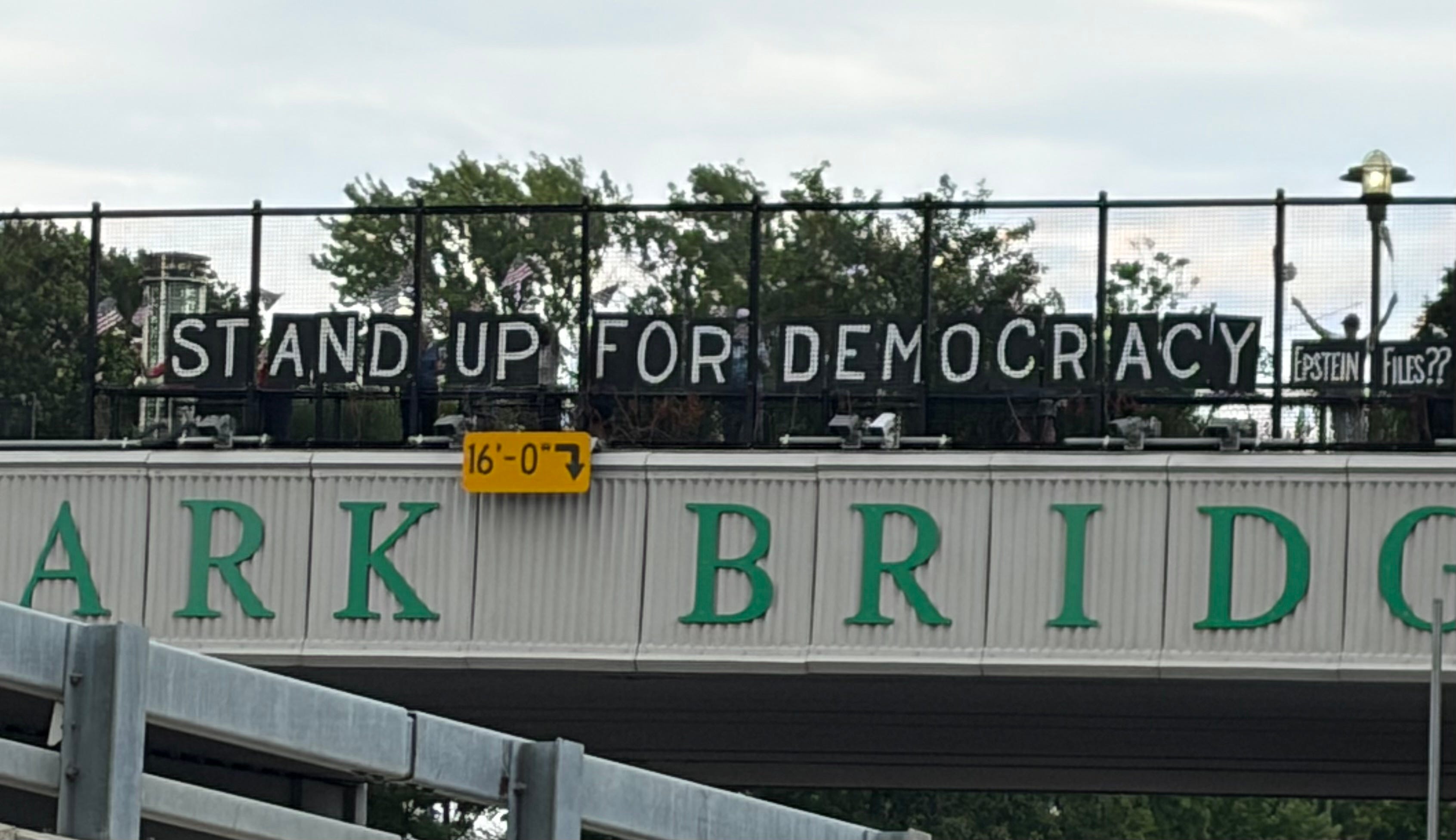

Thirteen of us were on the bridge today to wish America a Happy Birthday, but with a heavy heart. Our purpose today was to alert folks to the need to actively participate in our country’s growth. Otherwise…. Providence, RI.
=================================
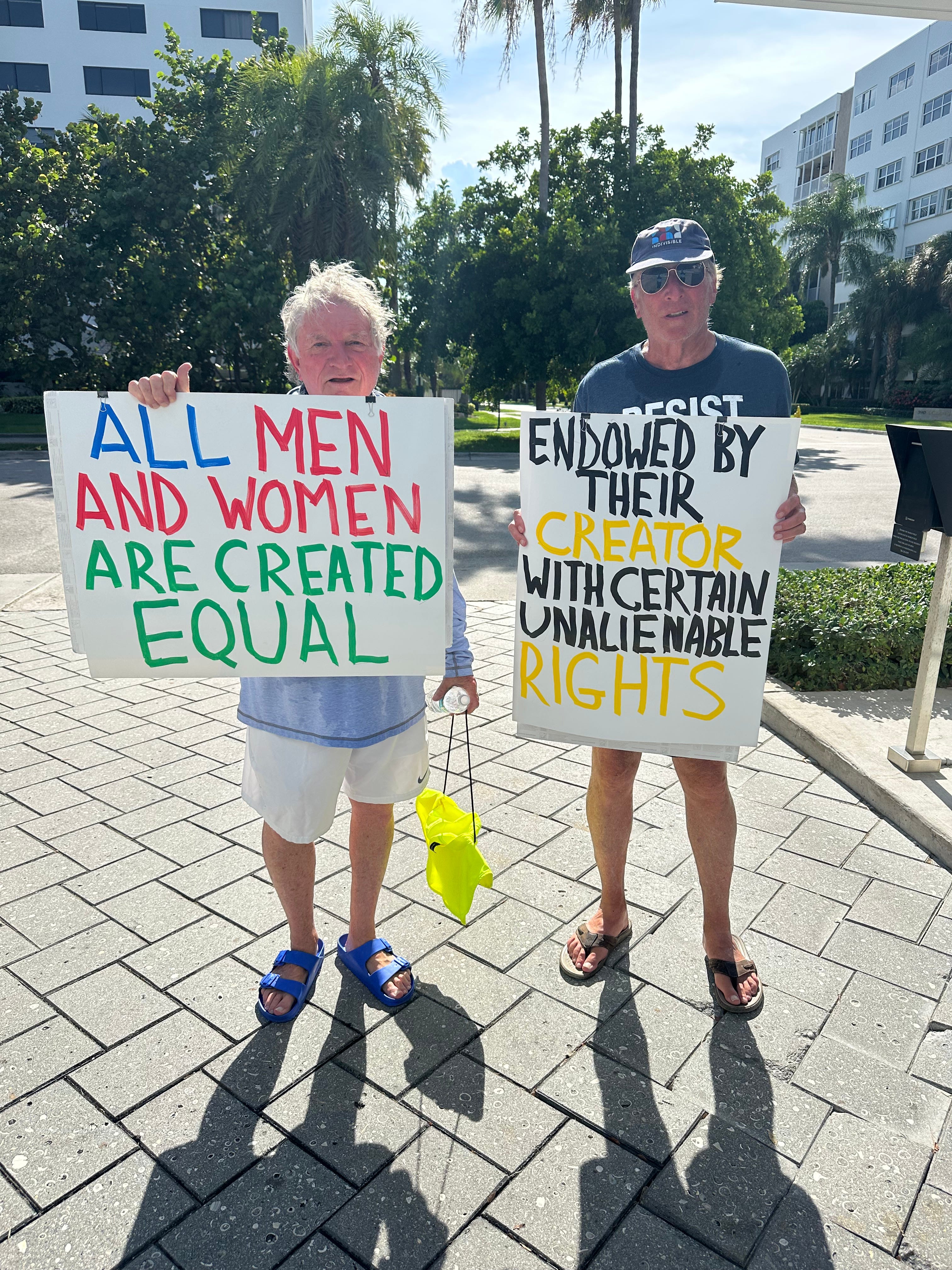
Key Biscayne, FL
=================================

June 30, 2026 in Pasadena, Ca. This message resounds powerfully with commuters, especially after this morning’s SCOTUS ruling against trans athletes.
=================================
The Supreme Court seems to be changing our Constitution. This makes no sense at all. Ruling that President Trump is above the law and cannot be indicted and tried for crimes committed while in office is – in the face of our history of breaking away from the rule of England and its kings – outrageous. Also, Trump's issuance of executive orders to disappear parts of the Constitution is equally outrageous. We have Article V in the Constitution that spells out the ways that our Constitution can be amended. None of these ways has any part in which the Supreme Court can be involved. I've always thought that Article V specifies the ONLY way to do that; not just one of other ways of doing so. Why is this not being pointed out by the mainstream press?
Eloquent and appropriately fiery, Robert.
Keep up the good work.